Picking a fence style feels a lot like choosing a paint color for your living room—you think you know what you want until you see fifty slightly different shades of “gray.” But here’s the good news: if you’ve landed on Aluminum as your material of choice, you’re already ahead of the game, especially living here along the Wasatch Front. Now, we just need to sort through the design details to find the one that fits your home, your dog, and your HOA requirements.
Wait, Why Aluminum in Utah?
Before we get into the pretty stuff like finials and colors, let’s address the elephant in the room. Why not Wood? Why not steel?
Honestly, look outside. If you live in Davis County or up on the benches in Salt Lake, you know the wind can be brutal, and the snow sits heavy. Wood rots. It just does. It warps, it cracks, and you spend every other summer staining it. Steel is incredibly strong, sure, but unless it is galvanized and coated perfectly, rust is going to be your new best friend.
Aluminum fencing is the sweet spot. It doesn’t rust—chemically, it just can’t. It handles the wet springs and the scorching July heat without flinching. Plus, most modern aluminum fences come with a powder coating that fuses the color to the metal, so you aren’t out there with a paintbrush in five years. It’s the “set it and forget it” option for fencing.
The Top Rail: Flat Top vs. Spears
The silhouette of your fence changes the entire vibe of your curb appeal. It’s usually the first decision you have to make. Do you want a clean, modern line, or are you looking for that classic estate look?
The Flat Top Look
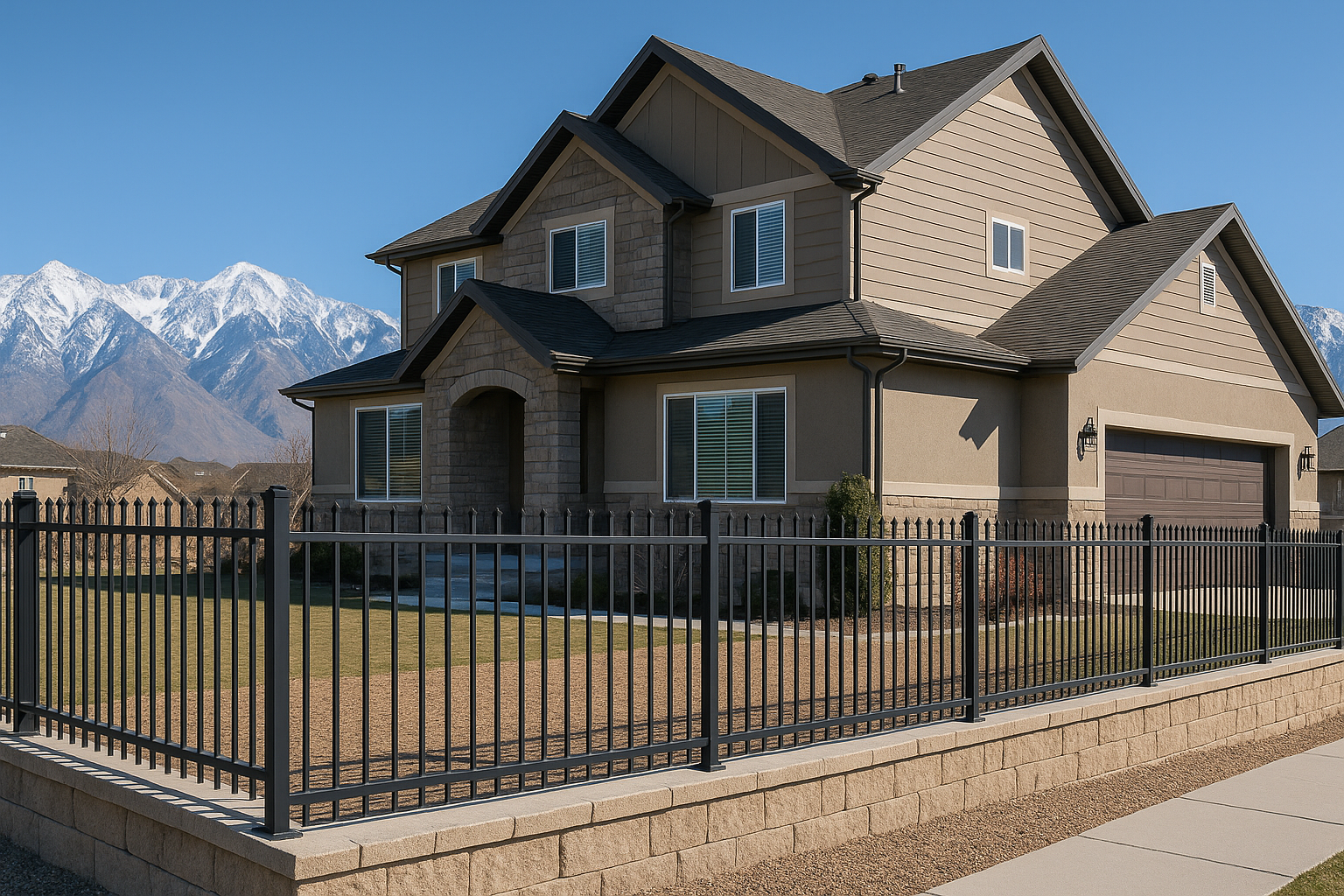
This is easily the most popular choice right now, especially for newer builds in Utah County (looking at you, Lehi and Saratoga Springs). The flat top rail runs smoothly across the top of the pickets. Nothing sticks up.
- Why people love it: It’s modern and safe. If you have kids who tend to climb things—even though we tell them not to—there are no sharp points at the top to snag a shirt or skin.
- The Look: It pairs perfectly with modern farmhouse or contemporary architecture. It disappears into the background a bit more than other styles.
The Spear Top (Pressed Point)
This is the classic look. You see this a lot in the Avenues or older neighborhoods in Bountiful. The vertical pickets extend past the top rail and end in a pointed shape, usually a “pressed spear.”
- Security Factor: It’s a subtle deterrent. It’s much harder (and more uncomfortable) to hop a fence with spears on top.
- Aesthetic: It screams “classic American fence.” It feels more ornamental and traditional.
There is also a hybrid options often called Flat Top with Spears. This features a top rail, but the pickets stop just below it, alternating with shorter spears. It’s fancy, intricate, and a bit busier visually.
Let’s Talk About “Puppy Pickets”
Okay, this is a big one. I can’t tell you how many times a homeowner installs a beautiful New Fence, lets their 10-pound Pomeranian out, and watches the dog walk right through the bars.
Standard aluminum picket spacing is usually around 3 and 7/8 inches. That’s enough to keep a Golden Retriever in, but a Chihuahua or a determined terrier? They fit right through.
Puppy Pickets (sometimes called short pickets) are the solution. Essentially, the bottom 18 to 24 inches of the fence has a second set of pickets inserted between the main ones. This reduces the gap to less than 2 inches.
You know what? It actually looks really high-end, too. It adds density to the bottom of the fence, making it look more substantial. If you have small pets—or even just want to keep the neighbor’s small pets out—this is a design option you shouldn’t skip.
Color Choices: It’s Not Just Black
For about 90% of our clients, black is the default. And for good reason. Black aluminum fencing mimics the look of traditional Wrought Iron. It’s stately and frames a yard beautifully.
However, you aren’t stuck with black if it clashes with your siding.
| Color Option | The Vibe | Best Application |
|---|---|---|
| Satin Black | Classic, Crisp, Iron-look | Fits almost any home; blends well with landscaping shadows. |
| Bronze | Earthy, Softer, Natural | Looks incredible against Utah’s red rock landscapes or brick homes. |
| White | Traditional, Bright, “Picket Fence” | Great for colonial styles, but be warned: Utah dust shows up on white fast. |
| Sandstone/Tan | Neutral, Blends in | Good for desert scapes or light stucco homes where you want the fence to disappear. |
Here’s the thing about bronze: It’s underrated. In bright sunlight, black can sometimes look stark. Bronze has a warmth to it that complements the brown and tan tones we see in our local mountains and foothills.
Handling the Hills: Racking vs. Stepping
Unless you live on the valley floor, there is a good chance your yard isn’t perfectly flat. Dealing with slopes is where a professional Installation really matters.
Racking (Following the Slope)
High-quality aluminum panels are “rackable.” This means the horizontal rails and vertical pickets are attached with a pin hinge system. We can angle the fence to follow the flow of the ground while keeping the pickets vertical.
- Why do this? It keeps the gap at the bottom of the fence consistent. If you have dogs, racking is usually the way to go because it doesn’t leave triangular gaps under the fence panels.
Stepping (Stair-Casing)
If the hill is too steep for racking, or if you just prefer the look, we “step” the fence. Each panel is installed level, but higher or lower than the one next to it, like stairs.
- The Trade-off: This leaves a triangular gap under the low end of each panel. We usually have to fill that gap with longer custom pickets or landscaping (like rocks or a retaining wall) to keep the yard secure.
Gates: The First Impression
The gate is the only part of the fence you actually interact with physically. You touch the latch, you swing the weight of it. It needs to feel solid.
From a design perspective, you have a distinct choice: Straight or Arched.
An Arched Gate breaks up the long horizontal line of a fence. It acts as a visual cue saying, “Hey, enter here!” It adds a touch of elegance. We can do single arches (like a rainbow) over a walk gate, or double arches (like an M shape or a swoop) over a large driveway gate.
Safety Note: If this fence is for a pool, the design of the gate isn’t just about looks; it’s about code. We have to use self-closing hinges and a MagnaLatch that is high enough out of a child’s reach. The gate must swing outward, away from the pool.
Finials, Rings, and Scrolls
This is the jewelry of the fence. You can take a standard panel and dress it up to look custom.
- Finials: These are the decorative tips on top of the pickets. You’ve got the Fleur-de-lis (very French/New Orleans), the Triad (three points), or the simple Ball Cap.
- Rings: These are circles inserted between the top two rails. It gives a very custom, estate feel.
- Scrolls: These are those curly-Q designs you see on old iron gates. We can add butterfly scrolls to aluminum gates to make them a focal point.
Sometimes, less is more. But if you have a historic home in Salt Lake City, adding some ornamental rings or gold-tipped finials can tie the fence into the history of the house.
Residential vs. Commercial Grade
You might not “see” this design option from the street, but you will feel it. Aluminum fencing comes in different grades, referring to the thickness of the metal walls and the size of the rails.
- Residential Grade: Perfect for defining a property line, keeping kids in, and general aesthetics. The rails are usually 1 inch or 1 1/8 inch.
- Commercial Grade: The pickets are thicker, the rails are beefier (often 1 ¼ inch or larger), and it can take a beating.
If you live on a busy corner in Sandy or West Jordan where snowplows push heavy snow against the perimeter, or if you run a business where security is a higher priority, upgrading to a commercial grade is a smart design choice. It looks roughly the same, but it stands stronger.
Privacy: The Aluminum Weakness?
Here is one slight contradiction. People want aluminum because it lasts forever, but they also want privacy. Aluminum is an “open” fence style. It’s meant to be seen through.
However, there is a workaround. We are seeing more designs now that incorporate aluminum privacy panels or “shadowbox” styles made of aluminum slats. These offer the zero-maintenance benefit of metal but block the view like a Vinyl or Wood Fence.
Alternatively, many homeowners use standard open aluminum fencing and plant privacy hedges (like Arborvitae) behind it. This gives you the security of the metal fence (“keep the dog in”) with the soft, green privacy of the shrubs (“keep the neighbors out”). It’s a classic combo that works really well in our climate.
Making the Final Decision
There is a lot to chew on here, right?
The best way to decide is to look at your property’s architecture. A sleek, mid-century modern home in Olympus Cove begs for a Flat Top Black fence. A Victorian in Lehi might need Spear Tops with Rings.
Also, think about your lifestyle.
- Got a pool? You need a specific height and latch type.
- Got a Pug? You need Puppy Pickets.
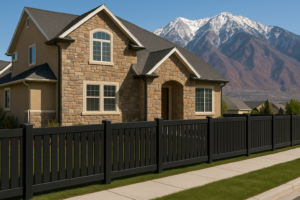
- Got a view of the mountains? Don’t get a tall privacy fence; get a low-profile open Aluminum Fence that disappears into the horizon.
Let’s Build Something Great Together
It’s easy to get overwhelmed by catalogs and photos. Sometimes you just need someone to walk the property with you, look at the slopes, and give you an honest recommendation on what will work best for your budget and your style.
At Utah Fencing Company, we’ve installed miles of aluminum fencing across Salt Lake, Utah, and Davis counties. We know what holds up to the salt and snow, and we know what looks good ten years down the road.
Stop guessing and let’s get your yard secured.
Call us today at 801-905-8153 or click below to get started.