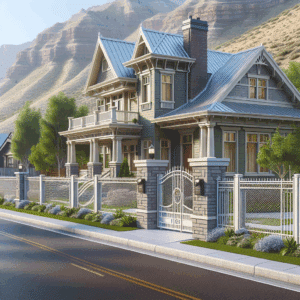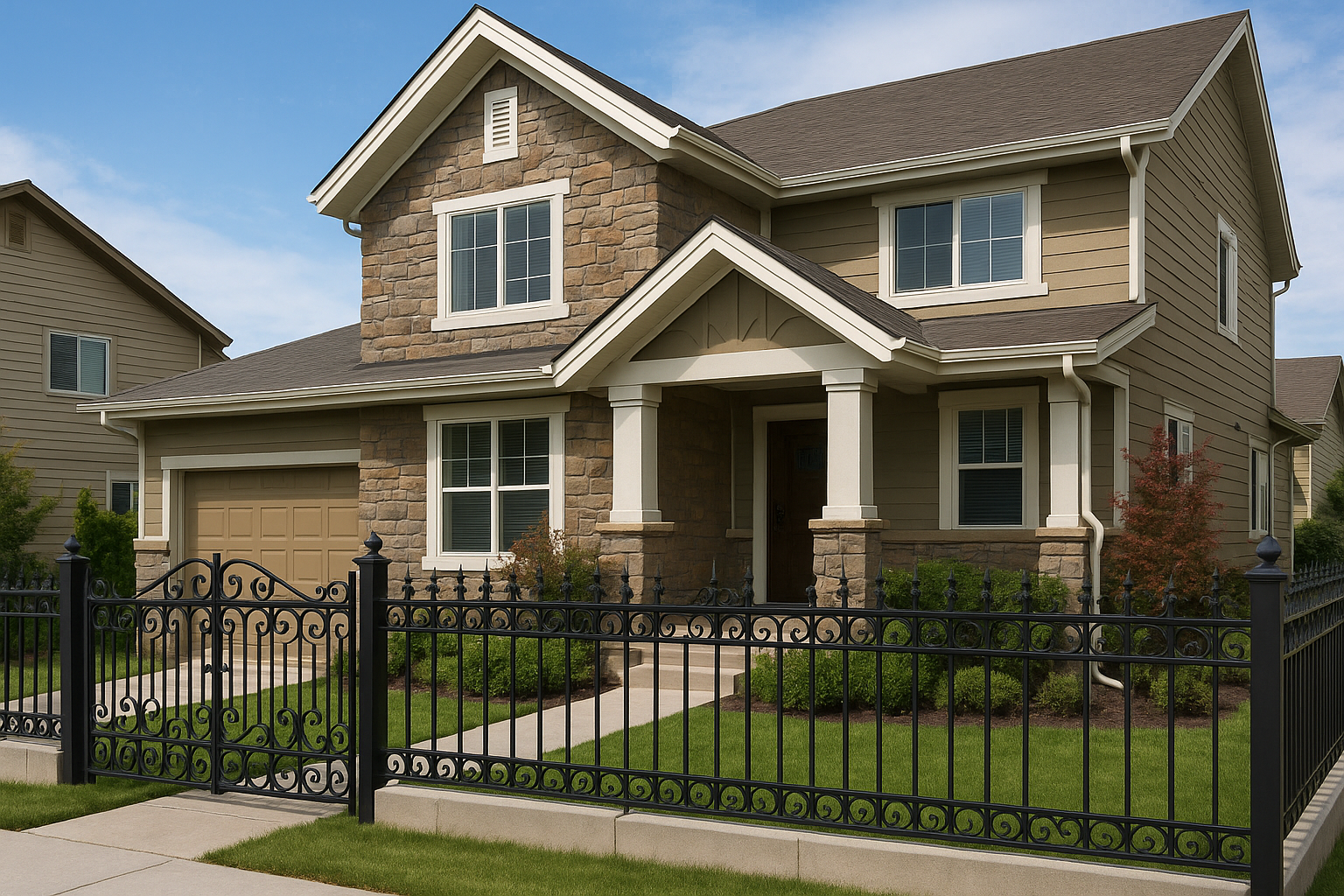
There is something undeniably timeless about pulling up to a home framed by a custom Wrought Iron Fence, especially against the backdrop of our mountains here in the Wasatch Front. It signals a level of permanence and elegance that Vinyl or Chain link just can’t quite touch, creating a boundary that feels more like architecture than a simple barrier. But if you’re sitting there thinking about upgrading your property in Salt Lake, Utah, or Davis County, you’ve probably realized that designing a custom fence involves a lot more than just saying, “I want the black metal one.”
Let’s Talk About What “Wrought Iron” Actually Is
Before we get into the nuts and bolts of design, we need to clear something up. Honestly, it’s a little bit of an industry secret. Most of the fences people call “wrought iron” today aren’t actually wrought iron in the historical sense. True wrought iron—the kind a blacksmith hammers out by hand on an anvil—is incredibly rare and astronomically expensive.
What you are likely looking for is custom ornamental steel or high-grade Aluminum that mimics the look of iron but offers better durability and affordability. But for the sake of tradition and conversation, we still call it wrought iron. It’s the heavy-duty, secure, and stylish fencing that protects estates in Sandy and secures businesses in Lehi.
Knowing this matters because it affects how you design it. Modern steel fabrication allows for some pretty incredible customization that old-school ironworking made difficult. You get the best of both worlds: that heavy, secure feel and the precision of modern manufacturing.
Step 1: Define the Purpose (It’s Not Just About Looks)
You might be thinking, “I just want it to look good.” And that’s valid. But the design changes drastically based on why you need the fence.
If you live in a busy area of Salt Lake City and security is the main driver, you are going to want taller pickets, perhaps with pressed spears on top to deter climbing. If you are in a family neighborhood in Layton and the goal is to keep a Golden Retriever inside the yard without blocking your view of the valley, you’ll want a simpler flat-top design with wider spacing (but not too wide, or the dog gets out).
Ask yourself these questions:
- Is privacy a concern? Iron is open by nature. If you need privacy, we might need to discuss backing the iron with mesh or Wood, or planting hedges behind it.
- Who are we keeping in (or out)? This dictates the spacing between the pickets. Standard spacing is usually around 4 inches, but we can tighten that up for small pets.
- What is the HOA saying? Yeah, we have to bring them up. Many HOAs in Utah County have strict guidelines on fence height and finial styles.
Step 2: Handling the Utah Terrain
Here is where things get tricky, and where a generic kit from a big-box store will fail you. Utah isn’t flat. Whether you are on the East Bench or nestled in the foothills of Draper, your property likely has slopes.
You have two main ways to handle a hill with iron fencing: Racking or Stepping.
Racking the Fence
Imagine the fence is “following” the slope of the ground. The rails remain parallel to the grade, and the pickets stay vertical. This creates a smooth flow and keeps the gap at the bottom of the fence consistent so the dog can’t squeeze under. It looks sleek and custom.
Stepping the Fence
This looks exactly like it sounds—like a staircase. Each panel is level, but attached to the post higher or lower than the one next to it. This leaves triangular gaps under the fence at the lower end of each section.
Which one should you choose?
Honestly? Racking is usually the better look for residential yards because it feels more integrated with the landscape. Stepping is often used for very steep grades where racking isn’t physically possible. If you have a retaining wall, we almost always bolt directly to the top of the Concrete for a clean look.
Step 3: Pickets, Rails, and Finials (The Fun Part)
Now we get to the actual visual design. This is where your personality shines through. A custom fence is made up of a few key components, and you can mix and match them.
The Rails: These are the horizontal bars. Most fences have two or three. A third rail near the top adds a lot of strength and a more substantial, “estate” look.
The Pickets: These are the vertical bars. You can go with standard square tubes, or upgrade to solid steel for a heavier feel.
The Finials: This is the jewelry of the fence. The finial is the decorative tip on top of the picket.
| Finial Style | Description | Best For |
|---|---|---|
| Pressed Spear | A pinched, pointed top integrated into the picket. | Security and a classic, clean look. |
| Triad / Fleur-de-Lis | Elaborate, three-pointed decorative top. | French Country or Victorian style homes. |
| Ball Cap | A round sphere sitting on top of the post or picket. | Modern or Craftsman homes. |
| Flat Top | No points sticking up; a rail runs across the top. | Safety (great for pools/kids) and modern aesthetics. |
You can also add scrollwork (those curly-q designs) or rings between the top two rails. A row of circles between the top rails is a signature look in places like Bountiful and adds a nice geometric break to the vertical lines.
Step 4: Gates are the Centerpiece
Don’t treat the gate as an afterthought. It is the handshake of your home. It’s the first thing people touch or drive through.
For a driveway gate, you want something that commands attention. We often design these to be taller in the center (an arched top) to create a focal point. You might want to incorporate your family initial or a specific custom scroll pattern.
Let’s talk automation.
If you are putting in a driveway gate in our climate, the motor matters. It gets cold here. Really cold. You need a gate operator that is rated for sub-zero temperatures and can handle the weight of steel. Cheap openers burn out when the metal contracts in January or when there is a heavy snow load. We usually recommend lift-master style heavy-duty operators that integrate with your phone.
For walk gates (the side of the house), think about the latch. You want a gravity latch that is key-lockable. There is nothing worse than a gate that rattles in the canyon winds because the latch is flimsy.
Step 5: The Finish (Fighting the Rust)
This is the most critical part of the process for Utah Fencing Company. You know how much salt gets dumped on the roads in Salt Lake County during winter? That salt mist, combined with our wet springs, is the enemy of iron.
If you just paint raw steel, it will rust within a year. No question.
To get a fence that lasts decades, we use a multi-stage coating process.
- Sandblasting: Cleans the metal down to the bare pore.
- Zinc Primer / E-Coat: This is an automotive-grade primer that electrically bonds to the metal to prevent rust creeping.
- Powder Coating: We don’t use wet paint. Powder coating is a dry powder that is sprayed on electrostatically and then baked in an oven at 400 degrees. It melts into a hard, plastic-like shell over the steel.
The result is a finish that resists chipping, scratching, and fading. Most people stick with Satin Black—it’s the classic choice for a reason—but we can do Bronze, Textured Black (hides dust better), or even White if you want that farmhouse vibe.
Step 6: Installation Logic
You can design the most beautiful fence in the world, but if the posts aren’t set right, gravity will win.
Here in Utah, the frost line is a real thing. The ground freezes and expands, which can heave fence posts right out of the ground if they aren’t deep enough. We dig our post holes deep—usually 24 to 30 inches depending on the specific location—and use a high-psi concrete mix.
Also, consider the spacing of your posts. Standard sections are usually about 8 feet long. If you try to stretch them to 10 feet to save money on posts, the fence will eventually sag. It’s simple physics.
A note on landscaping:
If you are building a new home, try to get the fence posts set before you lay sod or pour your final concrete flatwork if possible. It makes the installation cleaner. If your landscaping is already done, don’t worry. We treat your yard with respect, often hand-digging to avoid tearing up sprinkler lines.
Why Custom Beats Prefab Every Time
You might be walking through a home improvement store thinking, “I saw some panels in the garden center, why not just grab those?”
Here is the reality. Those panels are usually made of thin-gauge aluminum or hollow steel that crimps easily. The brackets are flimsy. And worst of all, they don’t rack. If you have a slope, you end up with a weird, gap-toothed look at the bottom of your fence.
When you go custom, every panel is welded to fit your specific measurements. If you have a tree root in the way, we adjust. If your property line runs at a weird 82-degree angle, we fabricate the corner to match. It is seamless.
Plus, there is the value add. Real estate agents in Utah County will tell you that a custom wrought Iron Fence adds significant curb appeal and value to a home. It suggests the house is well-built and secure.
Let’s Build Something That Lasts
Designing a custom fence is a balance between security, art, and engineering. It’s about creating a boundary that doesn’t feel like a cage, but rather a frame for your life. Whether you want a simple, modern perimeter for your business in West Valley or an ornate, scrolling masterpiece for your home in Highland, getting the details right makes all the difference.
We know the soil, we know the weather, and we know how to build fences that stand straight and true for a lifetime. You don’t have to figure out the racking angles or the frost depths—that’s our job. You just need to dream up the look.
Ready to see what your property could look like with a true custom border?
Call us at 801-905-8153 or Request a Free Quote today. Let’s get your project started before the season fills up.